How to Choose the Right Markers for Your Child?
Wondering which markers will survive the test of a child's creative expression while still washing easily off skin and clothes? Choosing the right tools matters hugely both for nurturing your little artist's talent and for every parent's peace of mind. We'll show you how to smartly match markers to your child's age and needs, so that creative play brings nothing but joy.

Popular Types of Markers
The variety of art supplies on the market can make your head spin. The choice of a particular type of marker depends above all on the child's age and the effect they want to achieve on paper or other surfaces.
-
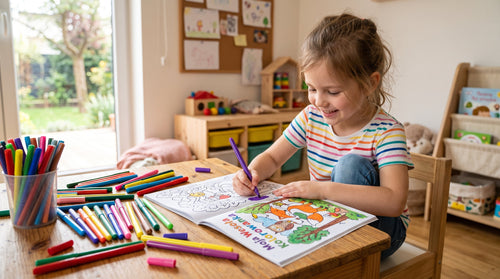
Water-based markers and felt-tips – Classic, safest tools for everyday colouring and drawing, easy to wash off skin and out of clothes.
-
Brush pens – They feature a flexible, brush-like tip that lets you create lines of varying thickness and teaches proper control of hand pressure.
-
Fineliners – Fitted with a very thin, precise tip; ideal for older children for detailed sketches, outlining and creating fine details.
-
Gel pens – They offer intense colours along with glitter or metallic effects that show up perfectly even on dark paper.
-
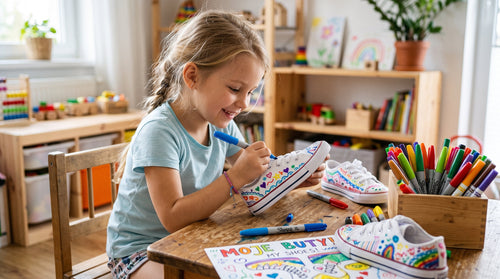
Acrylic markers – Filled with thick, opaque acrylic paint; they let you paint on unusual surfaces such as wood, stones, glass or plastic.
-
Alcohol markers – Designed for older children and teenagers passionate about comics or manga; they deliver perfectly smooth tonal transitions with no visible streaks.
What Can You Do with Markers?
Markers aren't just a simple tool for filling in pictures, but also versatile equipment that develops a child's creativity and fine motor skills. A well-chosen set opens up entirely new artistic possibilities for a child.
-
Classic colouring and drawing – Creating original illustrations and comics, and filling in favourite colouring books.
-
Calligraphy and decorative writing – Learning decorative lettering and creating headings for school notebooks with brush pens.
-
Painting on unusual materials – Decorating stones, personalising ceramics, decorating wooden boxes or clothing with acrylic markers.
-
Watercolour effects – Blending the ink from water-based markers with a wet brush to achieve a painterly, blurred background.
-
DIY projects and greeting cards – Handmaking cards, decorating diaries and adding sparkling details with gel pens.
What Should a Child's Markers Be Like?
When choosing supplies for the youngest children, it's worth considering not only aesthetics but above all safety and ease of use. Good children's markers need to withstand a child's creative expression as well as the occasional unexpected mishap.
-
Washable and easy to remove – Water-based ink should come off hands effortlessly under running water and wash out of clothes in a standard wash.
-
Non-toxic and safe – Products must carry the appropriate certifications (e.g. CE) and be free of harmful substances or strong chemical smells.
-
Pressure-resistant – The tip should be sturdy or locked so it doesn't push back into the barrel when pressed harder against the paper.
-
Ergonomic – A shape suited to small hands (e.g. a triangular cross-section) makes it easier to hold correctly and prevents the hand from tiring quickly.
How Many Colours for a Child?
Contrary to appearances, a bigger set doesn't always mean more fun, and too wide a palette can overstimulate a little artist. It's worth matching the number of colours in a set directly to the child's age and attention span.
-
Set of 12 colours (for toddlers aged 1-3) – Ideal to start with. It teaches recognition of basic colours, doesn't distract and lets children quickly tidy up once playtime is over.
-
Set of 24 colours (for preschoolers aged 4-6) – The happy medium for preschool age. It gives full freedom to create rich illustrations while introducing basic shades (e.g. light and dark green).
-
Set of 48 colours (for children aged 7 and up) – A choice for older children and drawing enthusiasts. The wide range enables smooth shading, tonal transitions and fine-tuning of details.
How to Choose Markers for Your Child?
To make the decision easier, we've prepared an overview that matches the type of markers to a child's age, needs and intended use. Find out what works best at each stage of development.
|
Child's age |
Recommended type |
Purpose |
Key features |
|
1-3 years |
Markers with a thick, locked tip |
First scribbles, colouring large shapes |
Super-washable, non-toxic, thick barrels that are easy to grip |
|
4-6 years |
Classic water-based markers (e.g. triangular) |
Preschool colouring books, learning the correct grip |
Easy to wash off skin and clothes, vivid colours, pressure-resistant |
|
7-10 years |
Brush pens, gel pens |
Calligraphy, school projects, decorating notebooks |
Varied effects (shimmer, glitter), flexible brush tips |
|
10+ years |
Acrylic markers, alcohol markers |
Advanced drawings, comics, personalising objects |
Durability, excellent coverage, smooth colour blending |