How to build a relationship with your child through play?
Did you know that the simplest way to earn your child's trust and understand their emotions is literally within arm's reach? Playing together isn't just a way to fill free time — it's a natural language your little one uses to communicate with the world. Whether you're stacking building blocks, racing RC cars, or simply goofing around together, your attentive presence lays the foundations for a lifelong bond.
Why is it worth playing together with your child?
Playing together creates a safe space in which the child feels seen, valued and fully accepted. A parent's involvement in the world of a child's imagination translates directly into the little one's emotional and psychological development.
-
Building a sense of security – a parent's steady, attentive presence gives the child a stable base from which to explore the world.
-
Developing emotional regulation – during play, the child learns to recognise, name and safely express difficult feelings.
-
Strengthening self-esteem – the time devoted to a child is a clear signal to them: "you matter to me and you're interesting to me".
-
Reducing stress levels – shared laughter and physical activity ease tension for both participants in the play.
-
Stimulating brain development – a secure relationship encourages the formation of new neural connections, developing creativity and abstract thinking.
What to play with your child?
You don't need complicated toys or expensive gadgets to build a relationship. The best results come from activities that engage the senses and imagination, and allow for genuine connection.
-
Board and card games – an excellent lesson in cooperation and logical thinking, as well as learning to cope with the occasional loss in safe conditions.
-
Role play and pretending everyday life – cooking, tidying up or puppet theatre together allow the child to process everyday experiences and build a sense of agency.
-
Sensory and movement play – an obstacle course made of cushions, wrestling games or gentle massages satisfy the need for physical closeness, stimulate the sense of balance and help with calming down.
-
Arts and crafts and building with blocks – these develop manual skills and spatial imagination, and offer huge scope for expression without judgement.
-
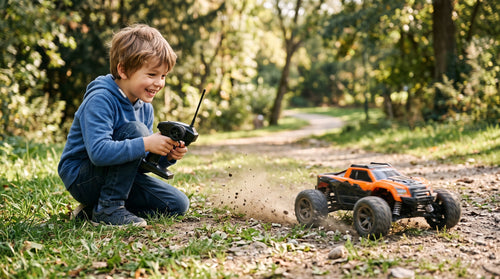
RC cars and interactive toys – designing an obstacle course in the living room together, organising family races or learning precise steering is a brilliant way to build a bond. This kind of play teaches spatial thinking, coordination and healthy competition, bringing plenty of joy to children and free fun for parents alike.

How to play with your child? – 5 tips
Simply "being in the same room" isn't enough to build a meaningful bond. Here are 5 tips that will make your time together truly close and enriching.
1. Be present
Put down your phone, switch off the TV and focus all your attention solely on your child — even if you only have 15 minutes a day for each other. Genuine, attentive presence gives your little one a clear signal that they are the most important thing at that moment. When you aren't distracted by notifications, you build a deep sense of security in your child. It's from these short but focused moments that real closeness is born.
2. Let your child take the lead
Let your little one become the director of the play and patiently follow their ideas. Don't immediately fix crookedly stacked blocks and don't impose ready-made scenarios from the outset. Children learn best through experimenting on their own and drawing their own conclusions. Your role is to accompany and support, not to take over or judge.
3. Enjoy the play
Children instantly sense our insincerity, so look for activities that bring you joy too. If you're not keen on themed toys, suggest a board game, some silly fun together or a trip to the park. Genuine, shared laughter lowers stress levels for both of you and brings you incredibly close. Good play should be a pleasure for the whole family.
4. Appreciate and praise your child
Focus on praising commitment, creativity and the effort made, not just the final result. Positive reinforcement builds stable self-esteem in a child and the courage to take on new challenges. Instead of a generic "nice drawing", appreciate the details: "I can see how hard you tried to pick these colours". This way, your little one feels truly seen and accepted.
5. Talk to each other after playing
A short chat after an activity allows you to move gently on to the next parts of the day and to reflect on emotions. Ask your child what they enjoyed most or how they felt in a particular role. It's a perfect moment for learning to name feelings and building mutual understanding. Setting a date for the next play session also gives your little one a sense of predictability and calm.